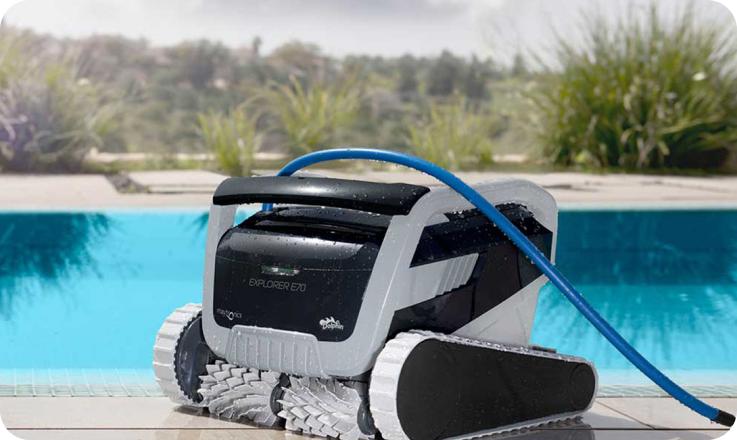
It is crucial to thoroughly look over your pool and its particular features prior to deciding on the right robotic cleaner for you. The efficiency of a robot depends on its compatibility with your pool. It is important to think about, because they could result in a less efficient cleaning process, damages to the pool or the equipment, or even buyer's regret. This complete guide lists the most important 10 details you need to know about your pool before buying.
1. Primary Surface Material
The most crucial aspect to be considered is this. The exterior finish of the pool determines the kind of brushing mechanism the robot will require to be able to scrub the pool without causing damage to it.
Concrete/Gunite/Plaster (including Pebble Tec & Quartz): These are rough, durable surfaces that often develop algae films. They require a robotic with stiff, bristle brushes (often nylon or vinyl-coated) that can aggressively scratch and scour the surface remove biofilm and dirt.
Vinyl Liner Vinyl is flexible, soft substance that can be easily scratched or punctured. The robots that are designed to work with vinyl require soft, non-abrasive wheel and brushes (typically comprised of pure rubber or vinyl). If you are using concrete cleaners or abrasive brush, the stiffness of the brushes can cause excessive wear and tear of the liner.
Fiberglass: Fiberglass shells have the most smooth, gel-coated finish. They are also susceptible to being damaged by abrasive substances. The best robots are those that have brushless rollers or brushes made of soft rubber. The smooth surface also often allows robots to clean more efficiently and using less power.
2. Complexity and size of the pool
The required length of cable and the required navigation intelligence are determined by the geometrical shape of your pool.
Rectangular Vs. Freeform: A straightforward rectangular pool is the easiest to clean. A majority of robots are capable cleaning it. Freeform, kidney-shaped or L-shaped pools are characterized by curves and coves that can trap simpler robots or completely miss. To ensure that the pool is fully covered it is recommended that a robotics system with an algorithmic navigation system (gyroscopic, smart-sensing, etc.) should be utilized.
Ledges or coves. The transition point where the floor meets the wall, (the cove), can be an area where debris tends to gather. Check that the design of the robot allows it to wash this curved area. Also, check if the pool is large enough with flat sun shelves and ledges (Baja shelves). Some robots are designed only for wall cleaning and floors.
3. Dimensions of the pool (Length, Width, and the Maximum Depth):
This is a must-have for selecting a device with a sufficient power cable.
Cable Length: The rule of general application is that the robot's cable should be at least as long as the largest dimension of your pool (usually the length) and some extra feet to accommodate routing around the perimeter of your pool and to ensure the power supply is kept away from water. 60 feet of cable is common for large to medium-sized pools. Measuring the pool's length is essential prior to purchasing.
Depth Capability Most modern robotics are able to clean deeps of 8-10feet without any issues. However, if you have an area that is deeper than 10 feet (e.g. an underwater pool), you must verify the depth rating of the robot's maximum. Exceeding it can strain the pump motor and invalidate the warranty.
4. Water Levels and Tile/Coping Details
The area between the water and the structure of the swimming pool is a crucial zone to be cleaned.
Waterline tile cleaning is a feature found on robots from mid-range to the top of the line price range. If you're suffering from constant scum staining on glass, tile or stone at the waterline, you need to look for a robot which claims to have superior waterline-cleaning capabilities. It is usually a little modified climbing pattern, and a dedicated brushing at the top of its climb.
Coping Material The material that is used to cover the wall of the pool can be stone, concrete or pavers. If the edge is sharp and rough edge, it can cause the cable to become stuck or cause it to be abrasive over time. When routing the cable be conscious of this.
5. In-Pool Obstacles and Features:
Clearing your pool is simpler than a pool filled with dangers.
Main Drains/Vents: Check that the vents' covers are flush with the floor and securely secured. Older drains that protrude can trap robots. The floor water return vents are usually not an issue.
These types of features, such as ladders, steps, and built-in seating, can disrupt a robot's cleaning patterns. Ladders placed on the floor with their legs could trap a robotic. To clear or climb up steps and benches, a robot requires power and traction. These areas can be avoided with simple, random navigation robots, but more sophisticated models can manage them.
Similar to steps, it's important to scrub large flat surfaces such as benches and swimming pools. Verify that your robot can navigate the horizontal surface.
6. The Robot's Entry and Exit points are from the Pool:
You should consider the practicalities of how you will remove the robot and back into the water.
Physical Access: Do you need to lift the robot up an incline or over a deck and then lower it back in? If that's the case the weight is a big factor. A robot that weighs 25 pounds is easier to manage on a week-to-week basis than a 40-pounder. It is crucial to have a storage cart in this scenario.
Above-ground Pools - While they are not as common however, there are some robots designed for above-ground pool. They tend to be lighter and not built to climb walls, as they are intended specifically for floors and the lower portion of walls.
7. The volume and type of debris:
The capabilities required will depend on what "jobs" the robot is required to perform.
Fine Dust/Pollen/Sand If this is your primary concern, a filtering system is crucial. To capture microscopic particle, you need a robot with cartridges that are ultra-fine (pleated paper) or with a very tight mesh.
Twigs, leaves and acorns for larger amounts of debris, you'll require a robotic with a big bag, canister or suction pump. It must also have an intake system that's not susceptible to clogging. Some models feature impellers specifically designed to crush larger leaves to keep them from getting blocked.
8. Location and type of outlet power source:
Robotic cleaners are powered by low-voltage DC power that is provided by an adapter that connects to a standard socket.
GFCI Outlet Requirement: The power supply MUST be connected to a ground Fault Circuit Interrupter (GFCI) outlet to ensure safety. This isn't a matter of negotiation. It is essential that you have an electric outlet near your pool, If you don't have one.
Distance from Pool. To shield the transformer from splashes of water and weather, place it at least 10 ft away from the pool edge. It is important to ensure that the cable is able to reach the pool's furthest edge from this point.
9. Local Climate and Storage Environment
The way you keep your robot will affect its lifespan.
Storage in the off-season: Numerous manufacturers advise against placing a robot in the water or in direct sun for long periods is not recommended. UV rays can degrade cables and plastic. If the robot isn't working for a prolonged time, it must be kept in a shaded cool, dry and cool location (like a garage).
Use in the Season If you're a frequent use of the robot, you could keep it in a storage container near the pool to prevent the cord becoming tangled.
10. Existing pool circulation and filtering:
The robot is not completely independent however, it is a part in the pool ecosystem.
Complementary Function - Understand that the main function of the robot is to clear debris from surfaces and eliminate any accumulated dirt. It's not meant to replace your pool's filtration and circulation systems and are responsible for filtering out dissolved particles and dispersing chemicals. The robot is an auxiliary cleaner that reduces the strain on the main filter.
Chemical Balance: A perfectly well-maintained surface may be prone to the growth of algae if the water chemical balance in your pool isn't in balance. The robot will assist in helping maintain cleanliness but won't replace the importance of proper sanitization. Check out the recommended pool-reinigungstipps for site tips including pool cleaning systems, cleanest pool, cleaning robot pool, pool cleaner with bag, swimming pool com, pool cleaner nearby, swimming pool crawler, technology pool, the pool cleaner, pool cleaning product and more.

Top 10 Tips To Assist You Get The Most From Your Pool Robot Service, Warranty, And Reputation
A robotic pool vacuum cleaner is a significant investment. It's a sophisticated, electro-mechanical machine that is designed to work in an extremely submerged environment. The performance capabilities might be appealing, but the value and peace-of-mind are secured in the end through the reliability of warranty, integrity and accessibility of customer support. These factors serve as insurance against costly and premature failures. repairs. A solid warranty demonstrates that the manufacturer is confident in their product and also a brand's name is built upon decades of trust. When a problem arises, as it will occur with any modern device, efficient and knowledgeable customer service becomes paramount. In the absence of this information, it can transform the best purchase into a gruelling and expensive paperweight.
1. Understanding the warranty structure Parts and Labor, as well as Seals.
A warranty is not something that can be considered as a whole. It is important to look at its individual components. What exactly is the 2-year warranty?
Replacement parts like the motor, control panel, or tracks are covered.
Labor: This is crucial. Does the warranty cover the cost of skilled technician labour to diagnose and fix the issue? Some warranties are only for components. You could end up with a high cost when the unit must be repaired.
Seals/Waterproofing. The seals that keep the water out are vital. Be sure that they are covered throughout the warranty period as their failure could be disastrous.
2. Understanding "In-Warranty" Service Logistics.
The repair of a damaged robot is a crucial factor to take into.
Mail-In Service: Most common. It is your responsibility to secure boxing the unit and sending it to a licensed service center, often at your own cost. It is essential to carefully pack the unit to avoid any harm during transport.
Local Authorized Service Centers. An benefit. Certain brands can offer local pool repair companies which have been granted authorization by the brand to take care of repairs under warranty. It is much easier to accomplish this than transferring the heavy, wet unit across the country.
Advanced Replacement Programs provide a higher level of customer care. The company will send you the replacement component immediately often before you have returned the damaged unit, which reduces your pool's downtime.
3. The importance of a warranty on swivel cables
The swivel cord serves as the lifeline of the robot. It is always moving, exposed to UV light, and is prone to tangle. It's a typical point for failure. Examine the warranty and check if it includes the cable. A complete warranty should be covered for the entire duration of the warranty. Some manufacturers may treat it as a "wear item" with a shorter coverage period, which is an important drawback.
4. Discovering the brand's longevity and market position.
A brand's history matters. A firm that has been making cleaning equipment for years has inevitably refined its designs, mastered common failure points, and established an efficient supply chain of parts. Companies that are fly-by-night and sell cheap robots via Amazon might disappear in one year, leaving you without a working product or warranty service. Be sure to buy from reliable brands.
5. The importance of model longevity and availability of parts.
Related to brand reputation Consider the length of time a particular model has been in the market for. A model that is in its fifth year of production is likely to have all the early design flaws fixed and have an abundant range of replacement parts, like filters, brushes or tracks, that are readily that are available for years after the model has been removed. New models are a risky bet on the reliability front.
6. Analyzing independent reviews and user feedback for patterns.
Read the reviews on retailer websites to determine what's actually happening. You can identify the most popular products by reading reviews in depth.
Positive Patterns - Search for praise that has been regular over many seasons for reliability, quiet operation, or even cleaning efficiency.
Negative patterns: Pay close focus on complaints that are repeated about the same part (e.g."my cable failed after 13 months "the motor sealed leaked") or poor navigation. These patterns indicate typical brand weaknesses.
7. Examining Customer Support Prior To Buying Purchase.
Check out the brand before purchasing.
Phone Support Do you have a public telephone number? You can dial it. Make it a call.
Online Resources Do they have an extensive website with downloads of user guides and FAQ sections, or videos, in addition to troubleshooting guides and tutorial videos? This is a sign of a company's dedication to self-service.
Email/Contact Forms: Send a pre-sales question. The speed and quality of the reply are solid indicators of the post-sales support you can expect.
8. Clarifying Warranty registration and Requirements
Learn the steps to activate your warranty.
Do I have to register? Certain warranties require registration on the internet.
Always retain your original receipt. It's usually required to verify any warranty claim because it establishes the date of purchase and establishes the warranty period.
Authorized Retailers: A purchase from an authorized retailer is generally an obligation to prove the warranty. Marketplaces that allow unlicensed third parties to sell products can invalidate your warranty.
9. Common Warranty Fraud Actions.
Warranty is a legally binding contract which you are able to violate. The most common actions that can invalidate a warranty include:
Extension Cords: They are generally banned because of the risk of voltage drop, and other dangers to safety.
Do not use an GFCI Outlet: If you plug your transformer into an outlet that isn't GFCI and it is not GFCI, it will invalidate the warranty.
Unlock the Sealed Unit. If you try to repair the motor, electronics or other parts yourself and the warranty is not honored, it will be void.
Using Non-OEM Parts: Using third-party filters or brushes that aren't specifically designed for the unit could cause coverage to be revoked.
10. Following the warranty, making plans for the future is essential.
Take a look at the life cycle of the product. What happens when the warranty expires?
Cost of Repairs. Inquire as to the typical cost of repairs that aren't covered by warranty, for example a replacement motor. This can help you decide whether it's more cost effective to repair the unit rather than replacing it.
Parts are readily available: A reputable manufacturer is likely to stock spare parts for several years following the time that a model has been discontinued. Brands with less recognition may not stock the parts and this could mean that any failure that occurs after the warranty time is a complete loss.
Certain models come with components such as brushes or tracks that are easily replaceable. This increases the lifespan of the unit much longer than the warranty period and reduces long-term ownership costs. Read the top rated robot piscines pas cher for website advice including any pool, smart pool cleaner, cleanest pool, aiper smart pool cleaner, swimming pool cleaners, pool cleaning how to, smart swimming pool, pool cleaner with bag, swimming pool cleaning schedule, smart pool cleaner and more.